
Genetic Research on Prostate Cancer
Different From Other Diseases:
“Genes interact in ways we don’t understand.”
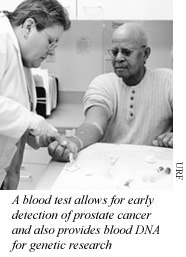 While the methods and goals of genetic research are similar, the diseases are not. Prostate cancer has its own set of circumstances with which genetic researchers have to contend.
Most Common Cancer in Men
First and foremost is the fact that prostate cancer is the most common non-skin cancer among men in the United States. The candidate pool, therefore, is large, much larger than in most other cancers.
Age Related
Also, prostate cancer is age related. In most men, it doesn’t present itself until they’re in their young senior or senior citizen years. Because much of present genetic research is family based, this age factor is significant. While brothers (and sisters) of most affected men might be available for DNA sampling and comparison; most likely, fathers and uncles (and mothers and aunts) are no longer alive.
Limited Pool For Genetic Sampling
While the candidate pool for prostate cancer is large, thereby creating numerous research directions, the actual pool for genetic sampling is limited – often to a single generation.
That limitation complicates the search for prostate cancer causing genes. Also, it explains the importance of volunteer participation in genetic research studies by people who have a family history of prostate cancer and who have family members available as well.
James Burmester, a scientist from Wisconsin who is also part of the team of researchers working with Dr. Catalona, points out that “;even though prostate cancer is the most frequently diagnosed cancer of men, we know very little about the causes of this disease. We still need to do a lot just to understand what causes the disease.”
Prostate Cancer Cells
While prostate cancer clearly begins in the prostate, a relatively small and accessible gland to examine; the prostate cancer cell itself creates complications for researchers.
Sydney Finkelstein, a pathologist who isolates prostate cancer cells for the collaboration, explains that prostate cancer cells operate differently from a lot of other cancer cells.
“Most cancer cells grow and spread at the same time and in the same place, creating a mass or tumor of cancer cells,” he says, “but prostate cancer cells never grow exactly as a solid tumor.
“They group up and incorporate into an expanding structure in the midst of normal cells. When prostate cancer cells spread, normal cells are there too.”
Because prostate cancer cells grow in-between normal cells, a scientist can’t simply take a sample from a cancerous prostate and get a hunk of tumor.
As molecular biologist Daniela Gerhard points out, “Scientists need to know they are looking at 100% pure cancer cells when they are searching for mutational changes. Normal prostate cells would, in fact, contaminate the study.”
The procedure to identify and isolate these 100% pure prostate cancer cells from affected prostate samples involves the use of an advanced technique called laser capture microdissection conducted by an experienced pathologist who knows what a prostate cancer cell looks like.
Cancer Cells With Wanderlust
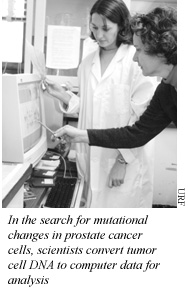 Prostate cancer is like other cancers in that the main cause of death is the spread of the primary tumor to a distant site, referred to as metastasis.
“Tumors are genetically unstable ” they have mutations and accumulate changes as they expand,” Gerhard explains.
“We know that prostate cells are only in the prostate but prostate cancer tumor cells start metastasizing. They get the wanderlust and start traveling first in the blood vessels and then into other tissues. They don’t want to be only cells in the prostate.”
But prostate cancer cells make another change.
Molecular biologist Jeffrey Milbrandt explains that “in the prostate, the tumors are androgen dependent, connected to male sex hormones. When they metastasize, spread to other locations, they grow in an androgen-independent manner.
“We are examining the differences between the two in our genetic studies of prostate cancer.”
Other scientists collaborating with Dr. Catalona are working on the same concern.
“The identification of genes involved in cancer metastasis remains a significant challenge,” says Graham Casey, a scientist in cancer biology.
“We are rigorously examining candidate genes to confirm their role in the metastatic process.”
Aggressive Or Non-Aggressive
All prostate cancer is not the same.
Some forms are aggressive and life threatening whereas others are not. The problem now is that no one has a means of identifying which is which.
“The PSA is a good screening test but it has no predictive value in this regard. The Gleason Score has some predictive value but it’s not precise enough to use in making decisions about life or death determining treatments,” Gerhard explains.
One goal of prostate cancer researchers is to find associations between genetics and aggressiveness of tumor cells.
Scientists Casey and Witte are doing research in this area.
“In a recent study,” Casey explains, “We determined a gene variant that seems to be associated with the development of more aggressive forms of prostate cancer in African American men.”
This finding is particularly significant as African American men are at a higher risk than other ethnic groups for developing not only prostate cancer, but also more aggressive forms of the disease.
“The identification of such gene variants should enable us to better predict for all men an individuals risk for developing aggressive forms of prostate cancer and should provide insights into prevention and treatment,” Witte says.
Family Or Environment
Present research would indicate that nine per cent of those diagnosed with prostate cancer are genetically predisposed to the disease.
Heredity is important for present genetic studies because it is from the familial genetic samples that potential gene regions are identified for further study, but the nine per cent figure indicates that heredity is probably not the only significant factor in actually causing the development of prostate cancer.
“The idea that any single gene is sufficient to cause all prostate cancer doesn’t seem plausible,” states Brian Suarez, statistician for Dr. Catalona’s research collaboration.
“Probably dozens of genes interact in ways we don’t yet understand. In addition, the increase or decrease in risk that comes from environment and diet, as well as genetic factors, will come into play. But we don’t know about these interactions yet,” he says.
Some scientists are beginning to study them.
“At the present time my applied research is primarily focused on deciphering risk factors for the initiation and progression of prostate cancer,” Ohio researcher John Witte says. “But our other work includes looking at the impact of diet – and diet gene interactions – on the risk of prostate cancer.
“We have shown that using some types of family members such as siblings in controlled studies, we can work on detecting gene-environment interactions.”